
Black-figure white-ground lekythos
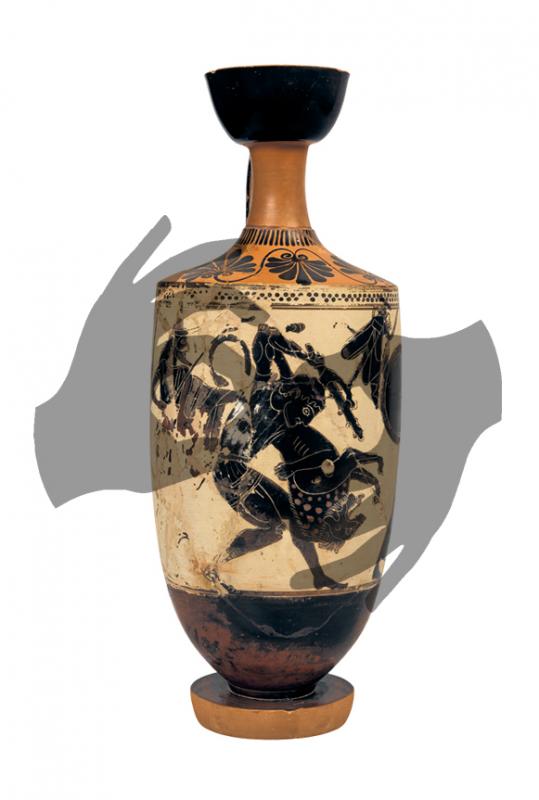
Black-figure white-ground lekythos
The decoration of this Attic lekythos is attributed to the Edinburgh Painter, one of the first important lekythos painters to use a white ground instead of the usual red colour of the clay. The white ground technique was to prevail henceforth in the best-quality lekythoi and on other vase shapes. The scene depicts Herakles poised to strike a lion (possibly the Nemean one) with his club, while Athena, Hermes and Iolaos watch. In myth, the birth, boyhood and youth of Herakles are placed in Thebes, whereas his maturity is placed in the Argolid. His youthful feats in Thebes relate mainly to ancient inter-Boeotian conflicts but sometimes they are variations of his labours in Argos. In a fit of madness, Herakles had murdered his own children. An oracle from Delphi ordained him to enter the service of Eurystheus, King of Argos, in order to expiate this crime. Eurystheus set him Twelve Labours, the first of which was to exterminate the Lion of Nemea. The representation most probably depicts this Argeian myth. Alternatively it may refer to a Boeotian version concerning the extermination of the Lion of Cithaeron. Herakles’ struggle with the Nemean Lion is one of the most popular iconographic subjects in the late Attic black-figure style.