

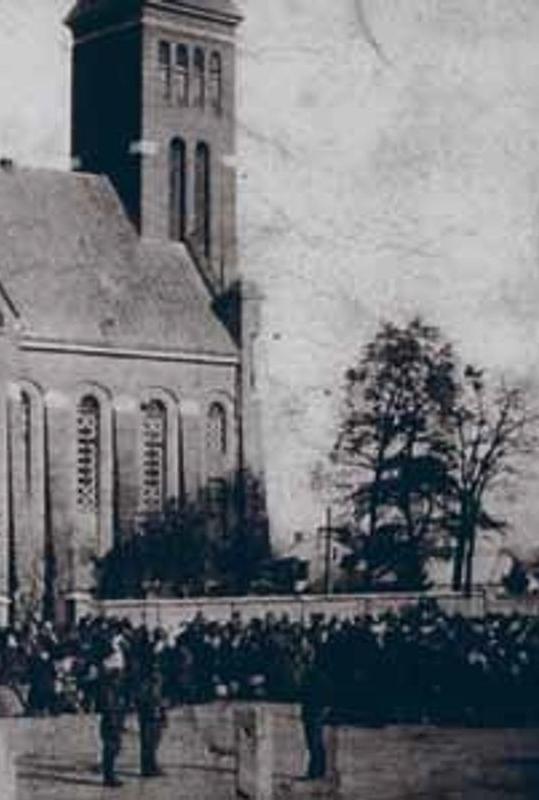
Komarów Osada - center of the village
Komarów Osada - Centrum miejscowości
The first source references to Komarov come from 1435.The village was the property of Wawrzyniec of Komarov.Probably around 1748 Komarov obtained Magdeburg city rights. At that time, the estate became the property of the Mier family, who founded the first church. In the 19th century. Despite numerous fires, the city developed rapidly in terms of demographics - between 1810 and 1910 the number of its inhabitants increased more than fourfold.In 1869 Komarów lost its municipal rights. Between the wars it was an agricultural, commercial and artisanal settlement, inhabited by Poles, Ukrainians and Jews, making up more than half of the population. In 1914. At Komarov, the Austrian army defeated the Russian army, and on August 31, 1920. Polish cavalrymen under Juliusz Rommel smashed Semyon Budyonny's mounted army. In December 1942. The settlement was pacified by German troops. The Polish population was taken to a resettlement camp in Zamosc, and the German population from Croatia was resettled in its place.Jews in Komarov - Until 1918. - Jews probably began settling here in the first half of the 18th century. and only in the mid-19th century. They formed an organized community with a wooden synagogue, a beit ha-midrash and a cemetery. It is also possible that the community and the facilities belonging to it already existed in the first half of the 18th century.In the 19th century, Komarów developed as a center of Hasidism. In the middle of the century, followers of the Tzadik of Kock established their shtibl here. Despite the regulations introduced by the tsarist authorities (in 1823) limiting Jewish settlement in the border strip - the community was developing demographically.At the end of the century Jews accounted for about 60% of the population. In 1900. A fire broke out in which the synagogue and approx. 30% of the buildings, inhabited by the Jewish population.Interwar period - At the end of August 1920. during the Polish-Bolshevik war, a pogrom took place in Komarov, in which soldiers of the Kuban Cossacks brigade of esaule Vadim Yakovlev, fighting on the Polish side, murdered 16 Jews, wounded 67 and raped 47 women. They also ransacked Jewish homes.Jews lived mainly in the area around the northern part of the market.There was a synagogue, a cemetery, a ritual slaughterhouse and a mikveh. Around the market there were Jewish stores (a textile store, a dairy store), a bakery and a restaurant. The settlement was home to Jewish political parties and institutions engaged in cultural and educational activities, including. founded in 1923. Tarbut Association and the Frajhajt Cultural and Educational Society.Holocaust - In October 1939. Along with the retreating Red Army, a large group of Jews fled Komarov to the east. After the Germans occupied the settlement, some of the Jews remaining here were deported to a labor camp in Zamosc.In the summer of 1941. Or as late as the first half of 1942. The Germans created an open ghetto in Komarow.In addition to the residents of the settlement, they resettled there about 1,300 refugees from other towns, including about 200 Jews from Lodz, Kolo, Sierpc, Włocławek, approx. 400 from Zamosc and about 700 from the Protectorate of Bohemia and Moravia.The deportation action in the ghetto began on May 23, 1943. - ca. 1,000 Jews were deported to Zamosc, and from there, on May 27, in a collective transport (together with Zamosc and Tyszowiecki Jews), they were taken to the Sobibor death camp. In October and November, the Germans shot about 2,500 people from the ghetto.Their bodies were buried in mass graves in a field near Komarov. .