

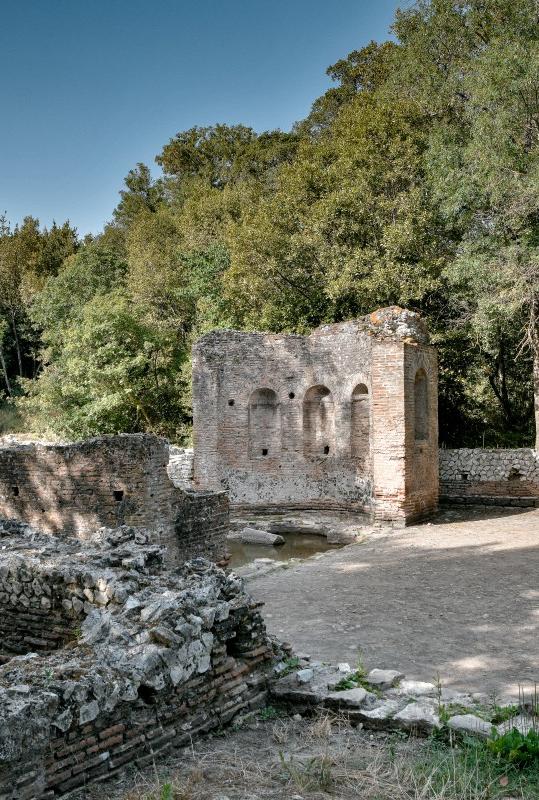
Was it really a Gymnasium?
The Gymnasium
A gymnasium was a common feature of Hellenistic cities, used for physical exercise, military training, and social activities. In the Greek world, gymnasia were comparable to modern sports and recreation centers, and were often built outside the city walls, as in Athens. The word comes from the Ancient Greek gumnazo, to exercise, and gumnos, naked or lightly clothed, reflecting the custom of training with minimal clothing.
However, the structure you see here was probably not a gymnasium at all. The name was given by the Italian archaeologists when the building was excavated, and it has remained in use ever since.
In truth, the building before you is most likely a Roman-period fountain, constructed in brick at the center of a courtyard surrounded by rooms. Its three niches are decorated with mosaics. At the center is a river deity with a thick beard, while on either side are identical images of drinking vessels. Its location beside the city's main streets suggests that the complex may also have had a religious function, perhaps replacing earlier shrines that disappeared during the construction of the forum. During the Middle Ages, the building was converted into a church, and a pagan inscription, now preserved in its basin, was reused as an altar.