

Carrer d'Aragó
Arriving at the city center
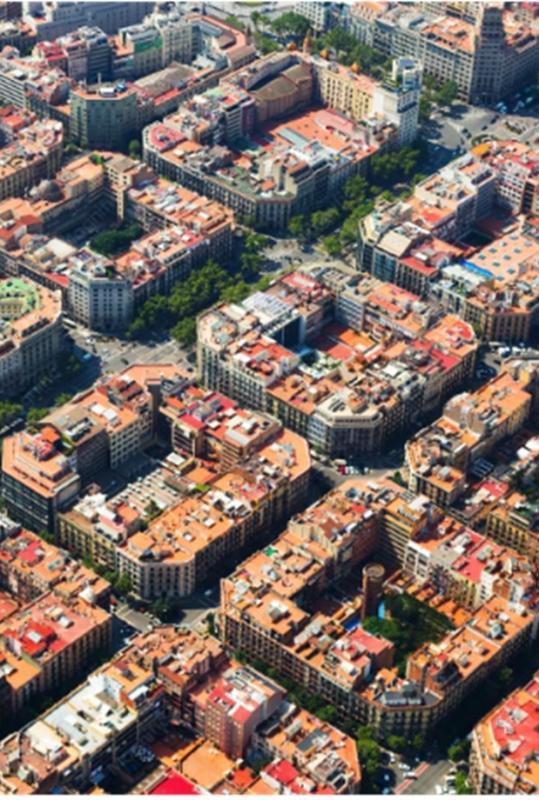
We are now travelling along Carrer d'Aragó, in the heart of Barcelona's Eixample district. From the upper deck of the bus, you can fully appreciate the remarkable width and seemingly endless perspective of this avenue, with its perfectly aligned façades and the distinctive chamfered corners that are the hallmark of Ildefons Cerdà's urban plan. Carrer d'Aragó stretches across the city from one side to the other and forms part of Barcelona's everyday life, combining elegant residential buildings, traditional local shops and architecture from different periods.
Now, we invite you to look to your left. Before you stands one of Antoni Gaudí's greatest masterpieces: Casa Batlló. Its undulating façade breaks completely with the conventions of traditional architecture and seems almost alive. The balconies resemble mysterious masks, the columns evoke skeletal forms, and the roof, covered with colourful ceramic tiles, is often interpreted as the back of a dragon. Many see the building as Gaudí's interpretation of the legend of Saint George, where architecture becomes symbolism. Built at the beginning of the 20th century, Casa Batlló is far more than a Modernist building—it is one of Barcelona's greatest architectural treasures.
Just a little further along, on your right, you will see the Museu Tàpies, housed in the former Antoni Tàpies Foundation. This striking Modernist building is crowned by the famous sculpture Cloud and Chair, one of the artist's most recognisable works. Inside, the museum displays one of the world's most important collections dedicated to Antoni Tàpies, one of Catalonia's leading contemporary artists.
Carrer d'Aragó perfectly reflects the spirit of Barcelona: a city where Modernist architecture, contemporary art and everyday urban life come together along a single avenue.