
Alexandra Paschalidou-Moreti refers:
The Artist and his Studio
(Extract from her lecture at the Museum of Cycladic Art. Alexandra Paschalidou-Moreti (1912-2010) was Eleni Zongolopoulou’s sister)
“Their first privately owned house was a rectangular stone building with roof tiles at Paleo Psychiko, including a large studio, a small living space and a bedroom on the attic. Eleni used to cook her famous risotto every Wednesday for their artist friends, among them Spyros Vassiliou, Frantzeskakis, Apartis, Yannis Moralis, Nikolaou, Kessanlis, Patroklos Karantinos, Chryssa Romanos. At the time, George was still working with clay and marble, also doing some architectural work, whereas Eleni was painting her naturalistic canvases influenced by Parthenis, her teacher.
Following their trips to Paris, Rome, Florence, and Venice, they both got rid of realism and started exploring new ways of expression. This required time, concentration and hard work, so they stopped organizing the Wednesday gatherings, visitors became scarce, and Eleni suggested that George resigns from the Ministry of Education in order to commit himself fully to his work – which he did, but it took a heavy toll on their lives; they even went through periods of hunger.
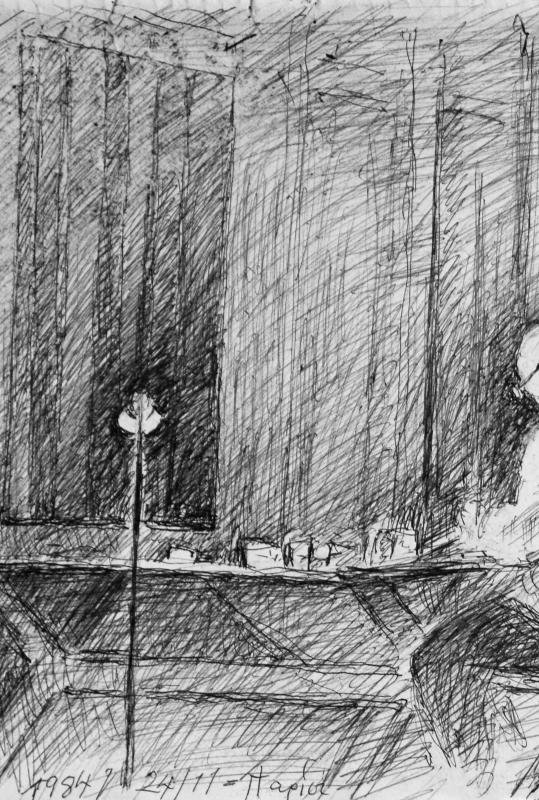
Years later, their stone house was demolished and a block of flats was built on the site. According to the land-for-apartment practice in Greece, they exchanged their house and land with several flats in the building, which they sold in order to buy a tiny studio in Paris. They used to live in Paris for long stretches of time in order to keep up with the contemporary art scene, as well as publish books on their art. They only kept a small semi-basement flat in the new building at Psychiko, where they lived for the rest of their lives. A small workshop in the garden became the sculptor’s studio, nothing like the large one he had before. It accommodated all the tools he used for working with bronze, stainless steel, iron, aluminum, Plexiglas, and the lenses – the new materials he had started using.
He managed to create large-scale sculptures by working on small scale while envisioning the large-scale outcome; he also considered his sculptures architectural pieces in conversation with the landscape. He would always start with greatly detailed scale model studies. Eventually, specialized technicians would realize and install his sculptures, always under his tireless presence and guidance.
He was lucky to see his large-scale works adorning public spaces and squares in Greece and many European cities (Athens, Kifissia, Nikaia, Thessaloniki, Crete, Mycenae, Delphi, Zalongo, Paris, Berlin, Brussels, Weimar, etc.)”